 YORUBA BAPTIST HYMNS / CASE STUDY
A hymnbook that feels like yours.
A personal reading platform built around faith, language and the everyday ways people use a hymnbook.
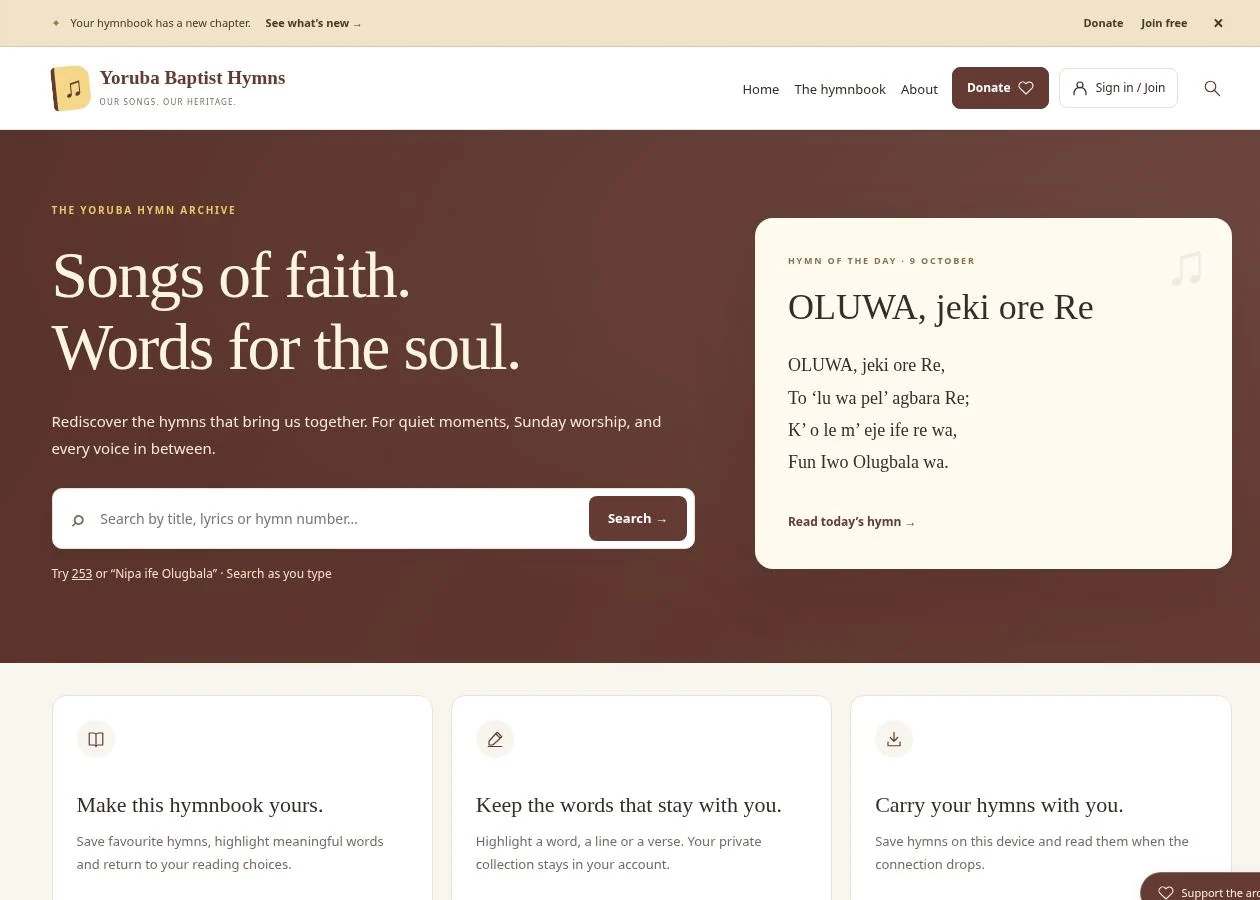
It began with a practical church need
I started this project with something simple: making the words of Yoruba hymns easier to find and use when preparing church bulletins. The hymns were already meaningful. What I could contribute was a more useful way to reach them.
Over time, the work became much more than publishing lyrics. It brought together my faith, my interest in technology and my desire to build something that serves people beyond a client brief.
The October 2026 release takes that work further. I have moved the platform from an archive people visit to a hymnbook they can make their own.
Building the foundation, not just the pages
I built two parts of the platform: Hymns Core, the WordPress plugin responsible for hymn content and reader features, and HymnsPlatform, the custom theme that presents them.
Separating the content from its presentation gives the archive a clearer foundation to maintain and develop. A change to the design does not need to change the identity of a hymn or the way its verses are stored. The foundation is also prepared for separate archives with their own language, content and branding, while Yoruba remains the focus of this release.
That required work beyond the frontend. I structured the source catalogue into verse and refrain blocks, retained source references and added an editor for ordering and revising lyrics. Import validation, preview mode and review flags give editors a way to handle uncertain records without silently rewriting the words.
The archive is a continuing editorial responsibility. Building a better system helps that work; it does not replace checking the hymn texts.
Remember a line. Find the hymn.
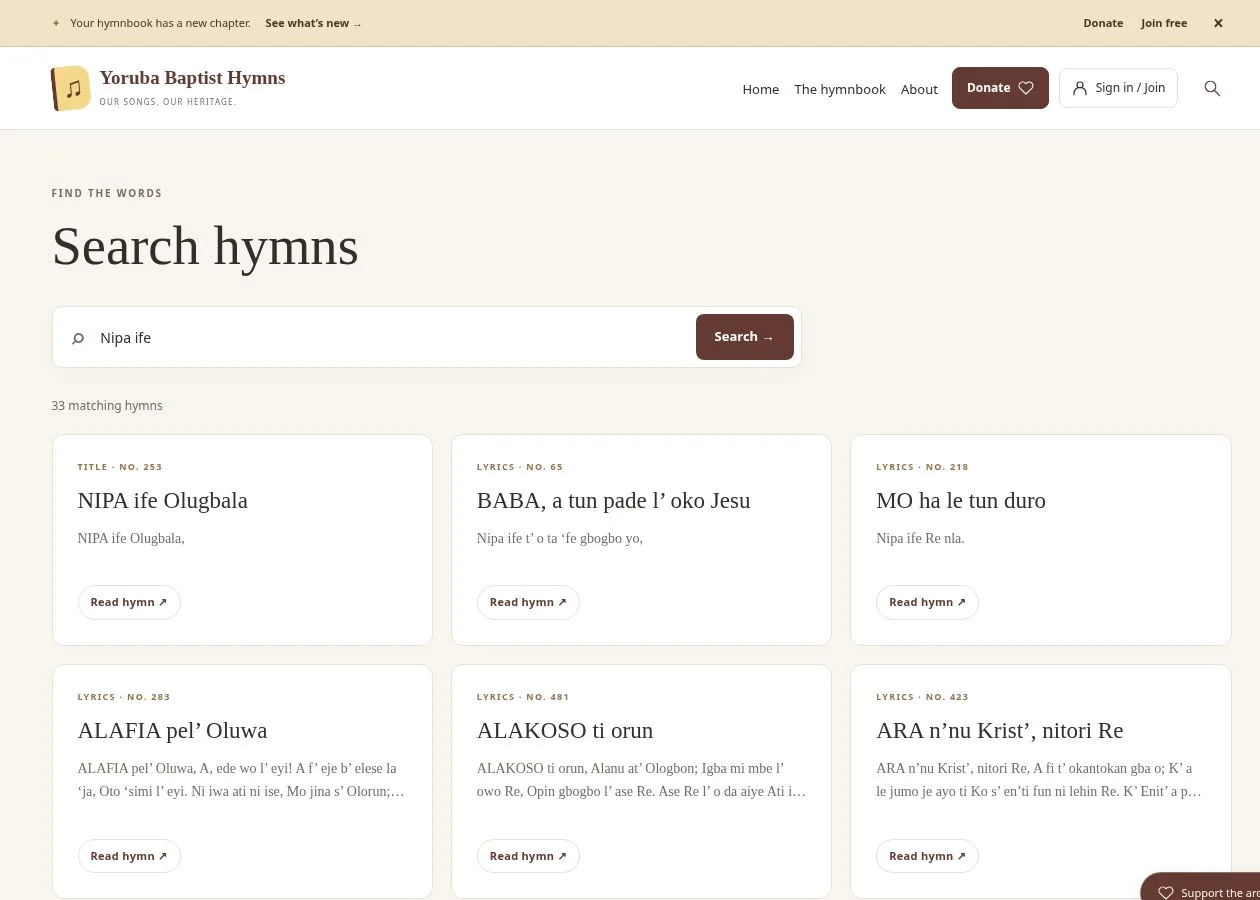
People do not always remember a hymn’s title or number. Sometimes they remember the words that stayed with them.
I built custom ranked search across titles, alternate titles, lyric words and hymnbook numbers. Matching is normalised behind the scenes while the original Yoruba text remains on display. Results distinguish title and lyric matches and show the relevant words, with suggestions appearing as someone types.
The product decision is simple: let people start with what they remember.
A reading experience with room for the reader
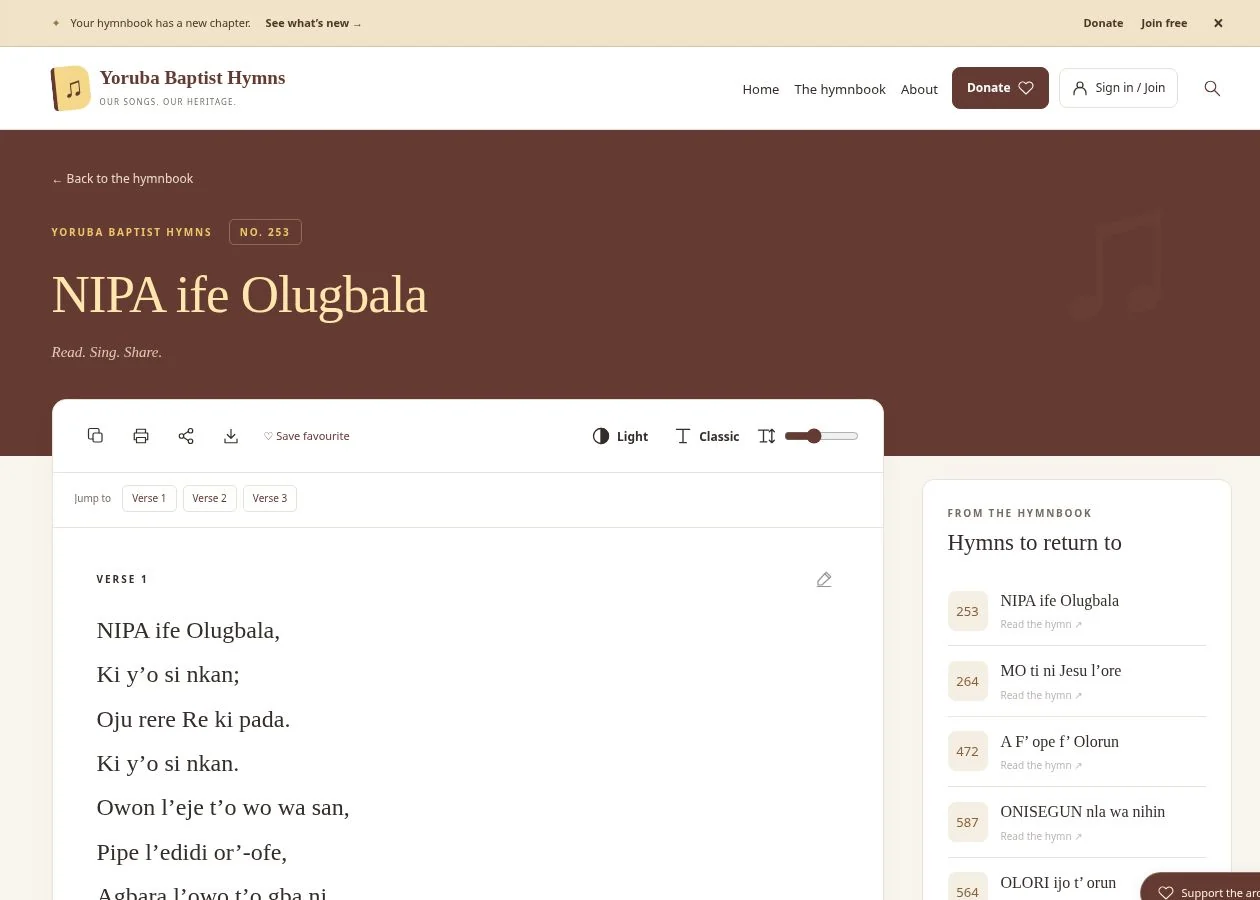
A hymnbook needs to work during worship and in quieter moments. I designed the reader around clear lyric blocks, direct verse navigation and controls for font, colour and text size.
Readers can choose light, warm-paper or dark reading colours. They can move straight to another verse, copy the hymn link, share selected words or print a clean version for worship.
Accounts add another layer of usefulness. Favourites become a personal hymn library. Highlights keep meaningful words in their verse context, with private reactions such as Prayer, Joy and Moved. Reading preferences belong to the reader, rather than being something they have to set up repeatedly.
I also built the account journeys around the same platform identity: profile management, password setup and recovery, branded emails and a place to return to saved hymns and replies.
Useful when the connection is not
I added a separate offline hymnbook so readers can save individual public hymns on their device and open them later without a connection or account sign-in.
The offline library has its own search and reading controls. It carries the downloaded words, not the entire unsaved catalogue. Keeping that boundary clear matters as much as making the feature convenient.
Performance is part of the reading experience
I rebuilt the platform with native WordPress, custom code, a dedicated theme and a dedicated plugin. The performance work sits alongside the interface work: the aim is to get people to the words with less friction, especially on mobile.
I treated discoverability and continuity as part of that foundation too. The build includes descriptive hymn URLs, metadata, structured data and migration tools for reviewing older paths. Stable hymn identities keep saved favourites separate from changes to public URLs.
The audience behind the next chapter
From 1 October 2025 to 30 September 2026, the platform reached 312,102 users and recorded 814,576 page views. Sessions grew by 23.07% compared with the preceding year, and Organic Search accounted for 90.02% of sessions.
These reporting periods precede the October 2026 rebuild. They show the archive’s reach, not the impact of the new release.
Audience and activity, year over year
Previous: Oct 2024 to Sep 2025 · Current: Oct 2025 to Sep 2026 · GA4
All bars start at zero and share the same scale. Users, sessions and page views are separate measures.
| Metric | Previous period | Current period | Growth |
|---|---|---|---|
| Users | 258,834 | 312,102 | 20.58% |
| Sessions | 499,090 | 614,220 | 23.07% |
| Page views | 678,052 | 814,576 | 20.13% |
Helping people find the hymns
Between 1 June 2025 and 1 October 2026, the website received 772,266 clicks from Google Search. Mobile accounted for 89.56% of those clicks.
| Metric | Result |
|---|---|
| Search clicks | 772,266 |
| Impressions | 3,613,521 |
| Click-through rate | 21.37% |
| Mobile share of clicks | 89.56% |
The Search Console window differs from the GA4 comparison above. Search clicks, users and sessions measure different activity.
Why I keep building it
For me, this is a way to contribute through the skills I have. It connects software development with language, faith and service.
Preserving an archive also means making it usable. Search helps people reach the words. Reading choices help them stay with the words. Favourites, highlights and offline downloads help them carry the words into everyday life.
The platform leaves room for people to contribute too, through moderated conversations, lyric corrections and support for keeping the archive freely available.
I am proud of the engineering, but the reason to keep doing it is the people it can serve.
Visit Yoruba Baptist Hymns